
Search engine optimization can feel complicated when you’re just getting started. There are technical terms, constantly changing search results, content guidelines, links, keywords, analytics, and many other factors to understand.
The good news is that you don’t need to master everything at once.
If you’re looking for SEO for beginners, the best approach is to first understand the fundamentals: what SEO is, how search engines work, how people search for information, how to create useful content, and how to make a website easy for search engines to understand.
This guide covers the essential SEO basics you need in 2026, from keyword research and on-page optimization to technical SEO, backlinks, AI-powered search, and measuring results.
Table of Contents
What Is SEO?
SEO stands for Search Engine Optimization. It is the practice of improving a website and its content so that search engines can better understand, discover, and rank its pages for relevant searches.
When someone searches for something on Google or another search engine, the search engine analyzes its available pages and attempts to provide the most useful results.
For example, someone might search:
- “best running shoes for beginners”
- “how to start a blog”
- “SEO for beginners”
- “how to fix a leaking faucet”
Businesses, publishers, bloggers, and organizations use SEO to increase the likelihood that their relevant pages appear in these search results.
SEO is generally considered an organic marketing channel because you’re working to earn visibility rather than simply paying for every click through an advertisement.
SEO vs. Paid Search
- SEO and paid search can both generate traffic from search engines, but they work differently.
- With paid search advertising, you pay to display advertisements for particular searches or audiences.
- With SEO, you optimize your website and content to earn organic visibility.
SEO can take time to produce meaningful results, particularly for a new website. However, a page that earns strong organic visibility can potentially continue attracting visitors without paying for every individual visit.
Why Is SEO Important?
People use search engines every day to find answers, products, services, businesses, reviews, tutorials, and information.
If your website appears when people search for topics related to your business, you have an opportunity to attract relevant visitors.
For example, imagine you operate an online store selling gardening equipment.
A potential customer searches for:
“best tools for a vegetable garden”
If your website has a genuinely useful page answering that question, search visibility could introduce that person to your brand.
SEO can help websites:
- Increase organic website traffic
- Reach people actively searching for information
- Generate leads and sales
- Build brand visibility
- Establish topical expertise
- Support other marketing channels
- Create long-term content assets
However, SEO isn’t simply about getting as much traffic as possible.
Relevant traffic matters more than traffic volume.
A page attracting 10,000 visitors who have no interest in your product may be less valuable than a page attracting 500 visitors who are actively looking for what you offer.
How SEO Works?
Understanding how SEO works starts with understanding the basic search engine process.
Search engines generally perform three important activities:
- Crawling
- Indexing
- Ranking
Let’s look at each one.
1. Crawling
Search engines use automated programs, often called crawlers or bots, to discover web pages.
A crawler can discover a page through:
- Links from other pages
- XML sitemaps
- Previously known URLs
- Other discovery mechanisms
When a search engine crawler visits your website, it can examine your pages and follow links to discover additional content.
If important pages cannot be accessed or discovered properly, they may have difficulty appearing in search results.
2. Indexing
After discovering a page, a search engine can analyze and store information about it in its index.
The search engine may process information such as:
- The page’s text
- Images and other media
- Structured data
- Links
- Page metadata
- Overall topic and context
Not every discovered URL necessarily becomes indexed.
Technical problems, duplicate content, quality considerations, accessibility issues, or other factors can affect whether and how a page is indexed.
3. Ranking
- When someone performs a search, the search engine determines which indexed pages are most relevant and useful for that particular query.
- Search systems consider many signals and systems when generating results.
- This is why SEO isn’t about finding one secret “ranking factor.”
Instead, effective SEO involves making your website:
- Relevant to the searcher’s needs
- Helpful and trustworthy
- Accessible to search engines
- Technically sound
- Easy for visitors to use
- Clearly structured
SEO Basics Every Beginner Should Know
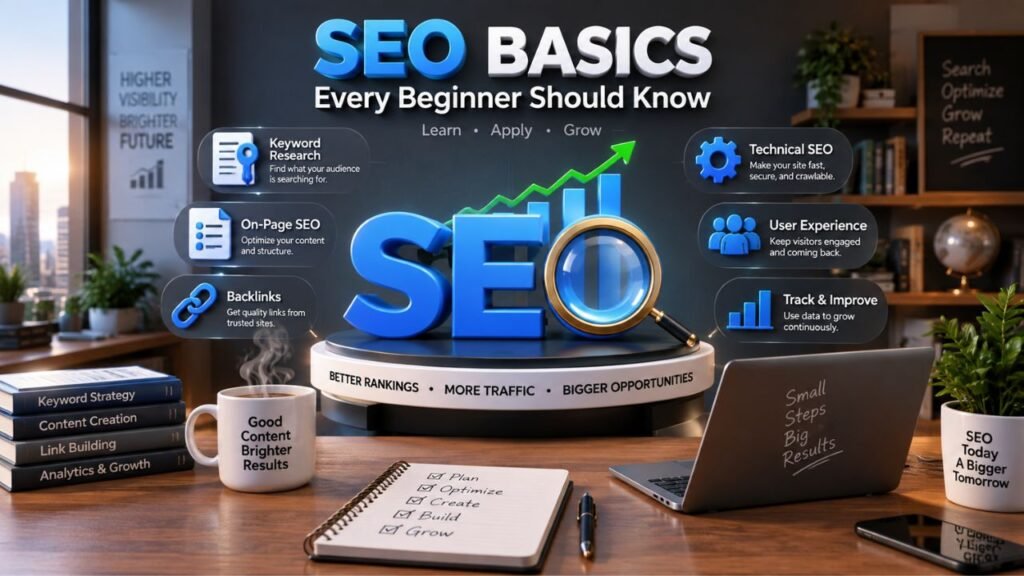
SEO contains many specialties, but you can organize the fundamentals into several major areas.
1. Keyword Research
- Keywords are the words and phrases people enter into search engines.
- Keyword research helps you discover what your potential audience is searching for.
For example, a website about photography might research phrases such as:
- photography tips for beginners
- how to use manual mode
- best camera settings for portraits
- landscape photography tips
- photography composition techniques
However, modern SEO should not be based on inserting the same keyword repeatedly into an article.
Instead, use keyword research to understand:
- What people want to know
- What questions they have
- What problems they are trying to solve
- What language they use
- What type of content they expect
Search Intent
Search intent refers to the underlying purpose behind a search.
Common types include:
Informational intent:
The person wants to learn something.
Example: “how does SEO work?”
Navigational intent:
The person wants to find a particular website or page.
Example: “Google Search Console”
Commercial investigation:
The person is researching before making a purchase.
Example: “best laptops for students”
Transactional intent:
The person is ready to complete an action, often a purchase.
Example: “buy running shoes online”
Understanding intent is one of the most important SEO basics because the best page for a search depends on what the searcher actually needs.
On-Page SEO
On-page SEO refers to optimization you make directly to your web pages.
Important elements include the following.
Page Title
The title helps users and search engines understand what a page is about.
A good title should be:
- Descriptive
- Relevant to the page
- Concise
- Naturally written
- Useful to the searcher
Instead of:
SEO Tips
consider something more descriptive:
SEO for Beginners: 15 Practical Tips to Improve Your Website
The second title communicates substantially more information.
Meta Description
A meta description is a short description associated with a page.
Although it isn’t simply a field where you insert keywords to improve rankings, a useful description can help communicate what users can expect when they encounter your page in search results.
For example:
Learn SEO from scratch with this beginner-friendly guide covering keyword research, on-page SEO, technical SEO, backlinks, AI search, and measurement.
The description should accurately represent the page rather than make exaggerated promises.
Headings
Headings organize your content.
A logical structure might look like:
- H1: SEO for Beginners
- H2: What Is SEO?
- H2: How SEO Works
- H2: Keyword Research
- H3: Search Intent
- H3: Long-Tail Keywords
- H2: Technical SEO
Clear headings make long content easier to understand and navigate.
URL Structure
A simple, descriptive URL is generally easier for users to understand.
For example:
example.com/seo-for-beginners/
is more informative than a URL containing a long string of unrelated parameters.
Internal Links
Internal links connect pages within your own website.
For example, an article about SEO basics might link to separate articles covering:
- Keyword research
- Technical SEO
- Link building
- Google Search Console
- Content strategy
Internal linking helps visitors discover related content and helps search engines understand relationships between pages.
Creating SEO-Friendly Content
- One of the biggest mistakes beginners make is writing primarily for search engines rather than people.
- Search engines exist to help people find useful information.
- Therefore, your content should start with the user’s needs.
Write for the Searcher
Before creating an article, ask:
- Who is searching for this information?
- What problem are they trying to solve?
- What questions are they likely to have?
- What information would make the page genuinely useful?
- What should the reader be able to do after reading it?
For example, if you’re writing about “how to plant tomatoes,” a useful article might include:
- When to plant tomatoes
- Soil requirements
- Seedling preparation
- Planting depth
- Watering
- Sunlight requirements
- Common mistakes
- Pest problems
- Harvesting
Simply repeating “how to plant tomatoes” throughout the article won’t make it genuinely useful.
Demonstrate First-Hand Knowledge
In 2026, generic content is increasingly easy to produce.
A stronger content strategy focuses on information that provides real value.
Depending on your subject, that might include:
- Original research
- First-hand experiences
- Case studies
- Expert commentary
- Original photographs
- Data
- Examples
- Comparisons
- Practical instructions
The goal is to give readers something they can’t get simply by reading dozens of generic pages.
Technical SEO
Technical SEO focuses on the technical aspects of your website that affect crawling, indexing, accessibility, performance, and user experience.
You don’t need to become a developer to understand the fundamentals.
Mobile-Friendly Design
Many people browse the web using smartphones.
Your website should therefore work properly across different screen sizes.
Check that:
- Text is readable
- Buttons are easy to tap
- Navigation works on mobile
- Images don’t overflow the screen
- Important content isn’t hidden
Website Speed
Slow pages can create a poor user experience.
Performance can be affected by:
- Large images
- Excessive JavaScript
- Poor hosting
- Unnecessary plugins
- Third-party scripts
- Inefficient code
Compressing images and removing unnecessary website elements can help improve performance.
HTTPS
- HTTPS encrypts communication between the user’s browser and the website.
- Modern websites should use HTTPS rather than unsecured HTTP.
XML Sitemap
- An XML sitemap provides search engines with information about URLs you consider important on your website.
- It can help search engines discover pages, particularly on larger or complex websites.
Robots.txt
- A robots.txt file provides instructions to crawlers about which areas of a website they may or may not crawl.
- It is important to understand that robots.txt isn’t a universal mechanism for keeping sensitive information private.
- Confidential information should be protected through appropriate authentication and access controls.
Core Web Vitals and User Experience
User experience is another important part of modern SEO.
Google’s Core Web Vitals focus on aspects of page experience related to loading performance, responsiveness, and visual stability.
The main metrics include:
- Largest Contentful Paint (LCP): loading performance
- Interaction to Next Paint (INP): responsiveness
- Cumulative Layout Shift (CLS): visual stability
These metrics can help website owners identify performance problems. However, improving these measurements shouldn’t become an end in itself. The larger goal is to provide visitors with a fast, stable, and usable website.
Off-Page SEO and Backlinks
- Off-page SEO involves signals and activities occurring outside your own website.
- One of the most well-known areas is link building.
- A backlink is a link from another website to your website.
- For example, if an industry publication references your research and links to your website, that’s a backlink.
- Links can help search engines discover pages and can provide signals about the relationships and reputation of websites.
- But not all links are equally valuable.
Focus on Quality
A natural, relevant link from a respected website can be more meaningful than large numbers of low-quality links.
Avoid tactics such as:
- Buying large quantities of backlinks
- Automated link spam
- Irrelevant link exchanges
- Manipulative anchor text schemes
- Mass-produced guest posts created primarily for links
Instead, create things people genuinely want to reference.
That could include:
- Original studies
- Useful tools
- Research reports
- Detailed guides
- Unique data
- Expert resources
Local SEO
If you operate a business serving a particular geographic area, local SEO can be especially important.
Examples include:
- Restaurants
- Dentists
- Plumbers
- Lawyers
- Gyms
- Salons
- Local retailers
Local SEO can involve:
- Accurate business information
- Business listings
- Local content
- Customer reviews
- Relevant local links
- Consistent contact information
- A properly managed Google Business Profile
For a local business, appearing for searches such as “dentist near me” or “plumber in [city]” can be more valuable than ranking for a broad national keyword.
SEO in the Age of AI Search
- SEO in 2026 is not limited to traditional blue-link search results.
- Search experiences increasingly incorporate AI-generated answers, summaries, conversational interfaces, and other forms of information discovery.
- This creates an important shift for website owners.
Instead of thinking only:
“How do I rank number one?”
consider:
“How can my website become a useful, trustworthy source of information?”
This means publishing content that is:
- Clear
- Accurate
- Well-structured
- Original
- Easy to verify
- Supported by evidence where appropriate
- Focused on real user needs
AI-generated search experiences may change how users discover information, but the underlying value of useful and trustworthy information remains important.
Should You Write Content Specifically for AI?
Rather than creating strange text designed exclusively to manipulate AI systems, focus on making your content genuinely valuable.
Use:
- Clear headings
- Concise answers
- Detailed explanations
- Original information
- Logical organization
- Relevant supporting evidence
- Descriptive page elements
Structured content makes it easier for both people and machines to understand.
E-E-A-T and Trust
Google’s search quality framework uses the concept of E-E-A-T:
- Experience
- Expertise
- Authoritativeness
- Trustworthiness
E-E-A-T isn’t a simple ranking score that you can maximize to reach a particular position. Instead, it provides a useful framework for thinking about content quality.
For example,
- A financial article could benefit from a clearly identified author with appropriate professional expertise.
- A travel guide could benefit from first-hand experience.
- A product review could provide photographs, testing details, and specific observations rather than simply repeating manufacturer specifications.
Trust is particularly important for subjects involving health, finance, safety, and other areas where inaccurate information can have significant consequences.
How to Start SEO: A Simple 30-Day Plan
If you’re completely new to SEO, don’t try to optimize everything simultaneously.
Here’s a practical starting framework.
Week 1: Understand Your Audience
Define:
- Who your target audience is
- What problems they have
- What products or services you provide
- What questions customers frequently ask
Then create a list of relevant topics.
Week 2: Perform Keyword Research
- Research keywords related to those topics.
- Group them into categories based on search intent.
For example, a fitness website might create groups around:
- Beginner workouts
- Weight training
- Nutrition
- Running
- Recovery
- Equipment
Choose topics where you can provide genuinely useful information.
Week 3: Optimize Your Website
Review your website’s:
- Page titles
- Headings
- URLs
- Internal links
- Images
- Mobile experience
- Site speed
- HTTPS
- Sitemap
- Indexing
Fix the most obvious technical and usability problems first.
Week 4: Publish and Improve Content
- Create useful content around your selected topics.
- Don’t focus on hitting a specific word count.
- Instead, cover the subject as thoroughly as necessary to satisfy the user’s intent.
- After publishing, monitor performance and improve pages based on actual data.
How Long Does SEO Take?
- SEO doesn’t have a universal timeline.
- A new website may need considerable time to establish visibility, while an established website with strong authority may see changes more quickly.
Results can depend on:
- Website age
- Competition
- Industry
- Content quality
- Technical health
- Existing authority
- Search demand
- Search intent
- Publishing consistency
- Links and mentions
- Algorithm changes
Avoid anyone promising guaranteed rankings within a specific number of days. SEO is better understood as an ongoing process than a one-time project.
How to Measure SEO Success?
Rankings are useful, but they aren’t the only measurement.
Track several metrics.
Organic Traffic
How many visitors arrive through organic search?
Search Impressions
How often are your pages shown in search results?
Click-Through Rate
How often do users click your result after seeing it?
Conversions
Are organic visitors completing valuable actions?
Depending on your business, a conversion could be:
- A purchase
- Contact form submission
- Phone call
- Newsletter signup
- Demo request
- Account registration
Revenue
For commercial websites, revenue from organic traffic can ultimately be more meaningful than rankings alone.
A page ranking first for a keyword that produces no business value isn’t necessarily more useful than a page ranking lower for a highly relevant commercial search.
Final Thoughts
SEO can look overwhelming when you first encounter it, but the fundamentals are straightforward.
At its core, search engine optimization is about helping search engines understand your website while providing people with useful, relevant, trustworthy information.
Start with the basics:
- Understand your audience.
- Research what they search for.
- Understand search intent.
- Create genuinely useful content.
- Optimize your pages clearly.
- Keep your website technically accessible.
- Build legitimate authority.
- Measure what happens.
- Improve your content over time.
The SEO landscape will continue to evolve, particularly as AI changes how people discover and consume information. But the fundamental objective remains remarkably consistent: create the best possible resource for the people you’re trying to reach and make it easy for search systems to understand and discover it.
If you’re learning SEO for beginners, don’t try to master every advanced technique immediately. Build a strong foundation in these SEO basics first. Once you understand how search engines discover, interpret, and rank content, more advanced concepts become much easier to understand.
Frequently Asked Questions About SEO
1. What is SEO for beginners?
SEO for beginners means learning the fundamental practices used to improve a website’s visibility in organic search results. It includes understanding keywords, search intent, content creation, on-page optimization, technical SEO, internal linking, backlinks, and SEO measurement.
2. How does SEO work?
SEO works by helping search engines discover, understand, and evaluate your website and its content. Search engines crawl web pages, store information in their indexes, and use many signals and systems to determine which results are relevant and useful for a particular search.
3. Why is SEO important for a website?
SEO can help a website attract relevant organic traffic from people searching for related information, products, or services. It can support brand awareness, lead generation, sales, and long-term online visibility.
4. What are the most important SEO basics?
The core SEO basics include keyword research, understanding search intent, creating useful content, optimizing titles and headings, improving internal linking, maintaining technical website health, earning relevant backlinks, and monitoring performance.
5. What is keyword research in SEO?
Keyword research is the process of finding and analyzing the words and phrases people use when searching for information, products, or services. It helps you understand what your audience wants and which topics may be relevant to your website.
6. What is search intent?
Search intent is the reason behind a search query. A person may be looking for information, a particular website, product research, or a way to complete an action. Understanding intent helps you create content that matches what searchers actually need.
7. How long does SEO take to show results?
There is no fixed SEO timeline. Results can depend on factors such as website authority, competition, content quality, technical issues, industry, search demand, and the site’s history. SEO generally requires consistent effort and ongoing improvement rather than immediate results.
8. Is SEO free?
Organic SEO does not require paying a search engine for every click, but SEO can involve costs for content creation, SEO tools, website development, technical work, consultants, or agencies. Businesses can also perform many basic SEO activities themselves.
9. What is on-page SEO?
On-page SEO refers to improvements made directly to a web page. These can include optimizing the page title, headings, content, URLs, internal links, images, and other elements to make the page clearer and more useful.
10. What is technical SEO?
Technical SEO focuses on the technical aspects of a website that affect crawling, indexing, accessibility, performance, and usability. Examples include mobile usability, HTTPS, site speed, XML sitemaps, redirects, and fixing crawling or indexing problems.
11. What are backlinks?
Backlinks are links from other websites to your website. Relevant, naturally earned links can help users discover your content and may contribute to how search engines understand the authority and relationships surrounding websites.
12. Is keyword stuffing still effective?
No. Repeating keywords excessively can make content unnatural and difficult to read. Instead, use keywords naturally while focusing on answering the user’s questions and covering the topic comprehensively.
13. Can AI-generated content rank in search engines?
Content should be evaluated based on its usefulness, quality, accuracy, and value to users rather than simply whether AI was involved in its creation. Using AI does not replace the need for original insight, fact-checking, appropriate expertise, and meaningful editorial review.
14. What SEO tools should beginners use?
Beginners can start with tools such as Google Search Console, Google Analytics, PageSpeed Insights, and keyword research platforms. You don’t need a large collection of tools to learn the fundamentals of SEO.
15. How can I start SEO as a beginner?
Start by understanding your audience and researching relevant topics and search queries. Then create useful content, optimize your website’s key on-page and technical elements, build relevant authority, and use performance data to continually improve your pages.
